LLMs, copyright and creativity in the age of Generative AI
The Writing the Wrongs of AI project started last year when I began to see social media posts from writers, outraged that their books had been hoovered up by big tech companies to train AI without their knowledge or consent, and with no attribution or remuneration. It was Val McDermid’s tweet pointing people towards a search tool that writers could use to check if their work had been used in this way that prompted me to put the project together. I wanted to find out what writers and publishers felt about the advent of AI and how it might affect their respective places in the literary ecosystem.
On a micro level this meant fears of AI taking jobs from creatives, and ethical issues around copyright, plagiarism and remuneration. On a more macro level, the project engages philosophical and economic arguments around creativity and originality, as well as the horrific consequences that energy-hungry GenAI has on climate change and the exploitation of a workforce in the global South who provide essential cheap labour in sorting and moderating GenAI data, yet receive none of the big tech profits.
Writing the Wrongs of AI is funded through a fellowship from the Bridging Responsible AI Divides (BRAID) programme with funds received from the Arts and Humanities Research Council, and is partnered with the Edinburgh International Book Festival (EIBF) as non-academic stakeholder on the project. The tone of the overall WWAI project is criticality and a pushback against the apparent inevitability of an AI takeover of the creative industries. I’ll be discussing the project at EIBF on 10th August 5.30-6.30pm – https://www.edbookfest.co.uk/the-festival/whats-on/writing-the-wrongs-of-ai
My work has always been around the changing values of language in a digital age, and I’ve used various creative and performative methods to do that in the past. My concerns are that when language is turned into data for storage or dissemination online, like all data it gains an economic value that negates and usurps the creative, the poetic, or the human value of the original words. That economic value is extracted by big tech companies such as Google, X, Meta, Amazon and now the AI behemoths such as OpenAI and Anthropic, which leaves us with the empty husks of language – the linguistic detritus that fills our search results with rubbish, boosts fake news stories, and now spews out AI nonsense generated using the stolen creative content of human authors without their knowledge or consent. Turning language into data, giving it economic value beyond its context and processing it through algorithmic systems designed specifically to make money for private companies is downright dangerous.
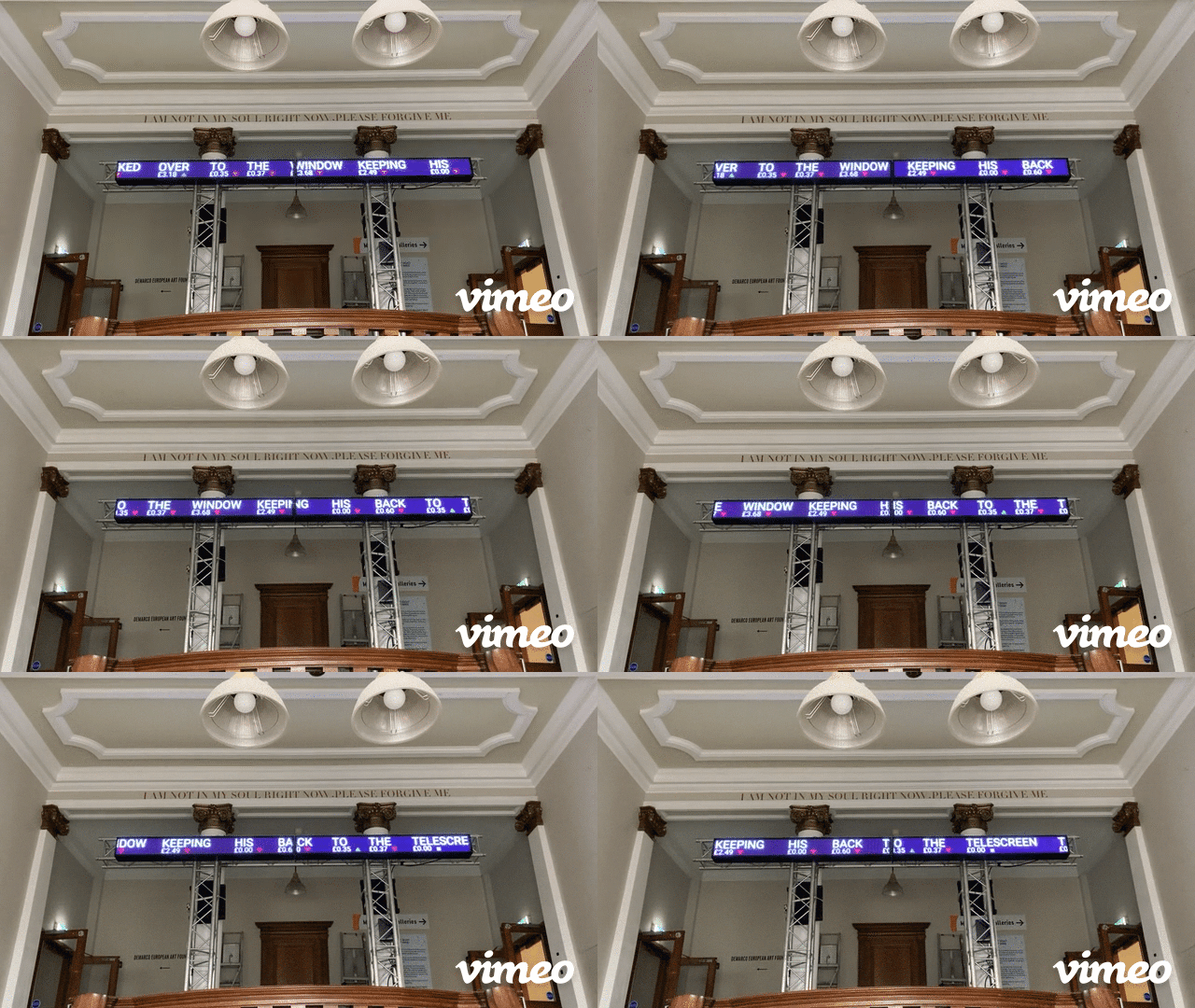
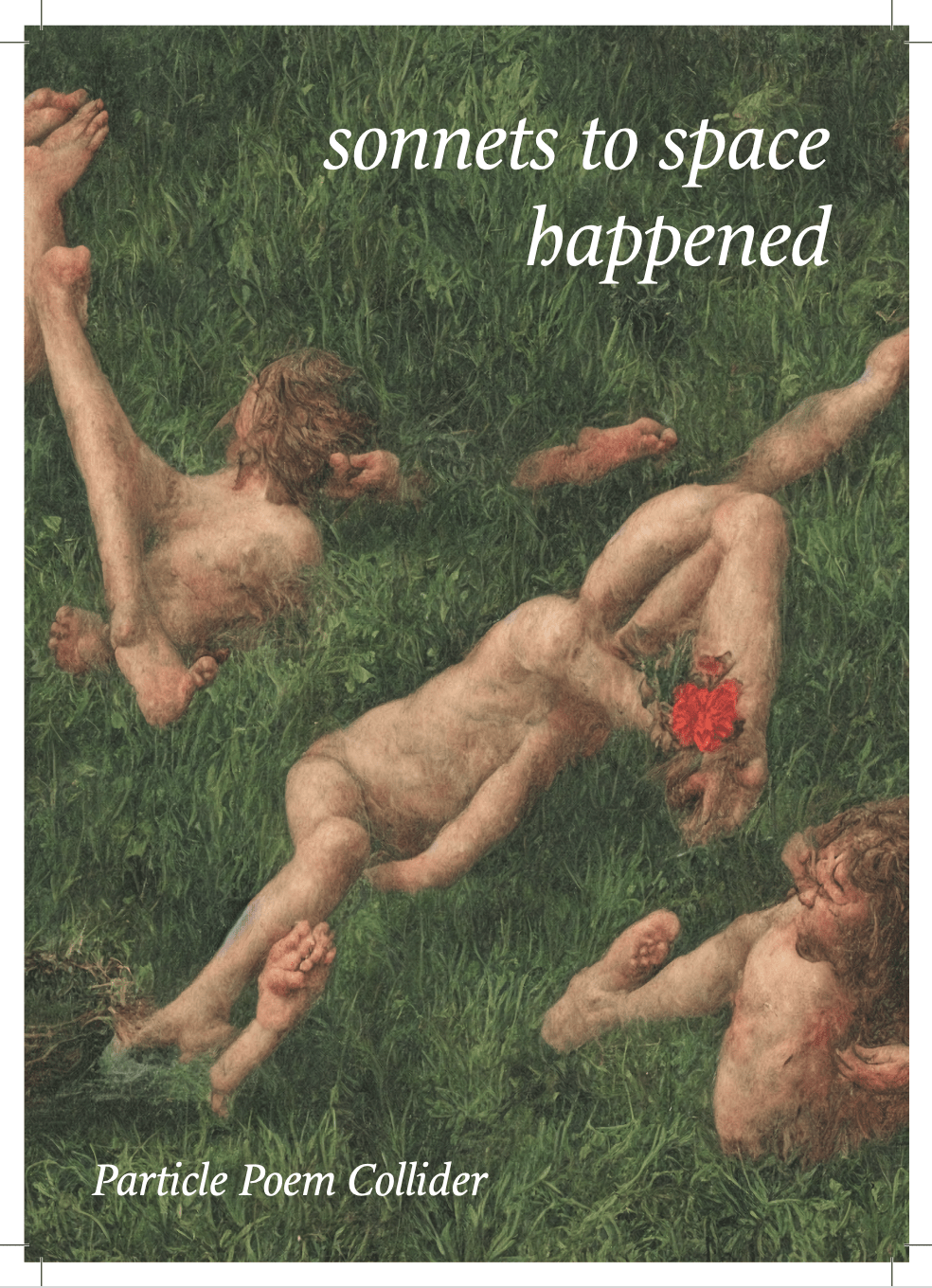
I’m in no position to challenge the terrifying power of big tech and the AI revolution, but what I can do, and have been doing for the last 10 years, is to use the power of language (as a tool of human expression, emotion and communication) to shine a light on the exploitative and extractive workings of these digital overlords, and to make people more aware of how their data is being used when they use these platforms. I’ve made artistic and theoretical interventions that use existing poetry and literature to show how Google commodifies language through its search and advertising platforms, designed workshops and interactive performances that critique language-grabbing ‘smart’ tech systems such as Amazon home assistants, Ring doorbells and other IoT devices, and co-created an exhibit and pamphlet built (consensually) on the collective creative content of a poetry festival. I also teach a masters module at the Edinburgh Futures Institute called Narratives of Digital Capitalism, which encourages students to imagine their own interventions into technologies that increasingly exploit our linguistic data for profit, while at the same time providing ‘services’ that can harm and discriminate (e.g voice recognition, translation software), threatening the planet with their astronomical carbon footprints, and exploiting cheap human labour.
Writing the Wrongs of AI, and the interventions that have sprung from it, is therefore the next iteration of a research trajectory which began with my PhD thesis 10 years ago. With the help of the Book Festival, we managed to recruit an amazing group of writers, publishers, poets, playwrights and translators and held 3 workshops here in Edinburgh in May-June this year. We had input from creative technologists, experts in digital economics, data security and two experts in copyright law who were able to answer so many of the burning questions our participants have. We debated the perils and pitfalls of AI, but also discussed how AI such as ChatGPT can be used for good, especially around issues of equality, diversity and inclusion, and indeed for helping with writers block, or for experimentation.
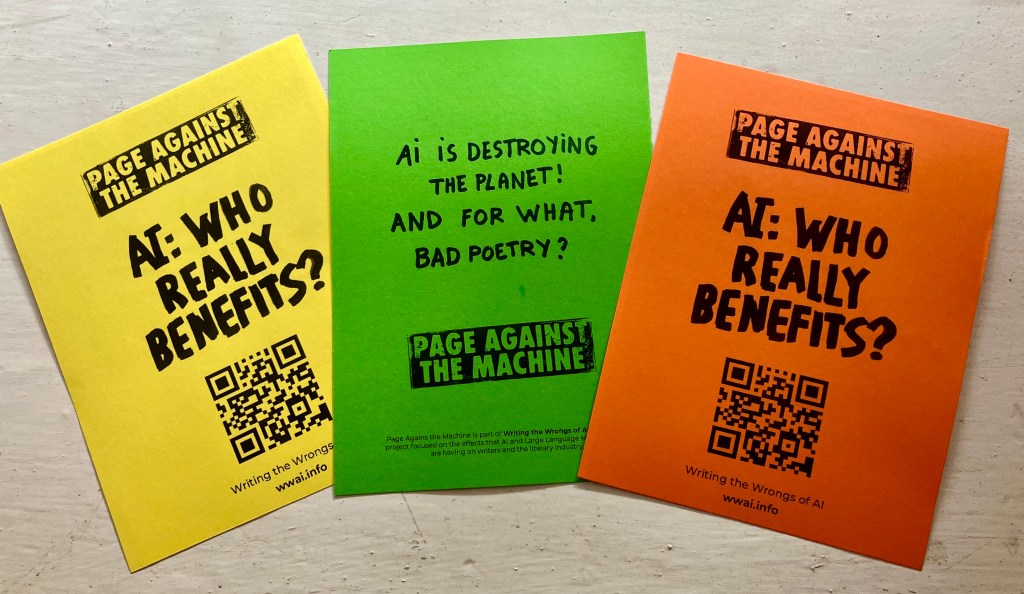
Together, we dreamt up a series of playful but critical interventions addressing the issues raised in the workshops. These can be found on a project-specific website www.wwai.info, but the one that has grown arms and legs is called Human Verses Machine, which is a satirical installation that will run for the duration of the Edinburgh International Book Festival 2024. Human Verses Machine showcases the launch of a fully working spoof “automatic writing machine”, a revolutionary new tool which promises to help users write their masterpiece, maximise their creative output and to alleviate mankind of the drudgery of creative writing. The machine helpfully chips in when you’re short of inspiration, but – and without revealing too many spoilers – there are twists. The machine takes liberties, and provokes some unexpected resistance. The climax of the intervention is the performance of a custom-written short play which parodies the actual product launch of the ‘automatic writing machine’. This event – Page Against The Machine: Writing in the Age of Artificial Intelligence – takes place in the EIBF Spiegeltent on 19th August 6pm-7pm. More info and tickets here: https://www.edbookfest.co.uk/the-festival/whats-on/page-against-the-machine
Human Verses Machine was designed by WWAI team members Sam Healy and Brendan McCarthy of Edinburgh based creative technology company Ray Interactive, with the help and feedback of the whole WWAI community. The script for the Page Against The Machine play was written by another WWAI participant Clare Duffy of digital theatre company Civic Digits.
Human Verses Machine and the Page Against the Machine play are designed to introduce participants to the powers, but also the dangers of artificial intelligence as it applies to writing and publishing and the wider world, and to get people thinking about who really benefits from Generative AI systems such as OpenAI’s ChatGPT or Anthropic’s Claude chatbot. And speaking of Anthropic, while we’ve been incredibly lucky that the Book Festival has trusted us and given us the freedom to develop and showcase what is a profoundly critical project, I was more than a little surprised that the Edinburgh Fringe has entered into a partnership with Anthropic AI. The Fringe are hosting representatives from Anthropic to hold workshops with academics, creatives and media professionals which ostensibly claim to show us how AI can be good for the creative industries, but in essence are little more than marketing opportunities to tout their product (and potentially to try to capture the UK market from rivals OpenAI?). Anthropic calls itself an ‘AI safety and research company’, and claims to be more ethical than OpenAI, but all of the issues addressed by Writing the Wrongs of AI and our Human Verses Machine interventions apply just as equally to Anthropic, indeed their AI chatbot is trained on exactly the same dataset of stolen work as ChatGPT, including, somewhat ironically, the creative content of many Fringe performers past and present. I want to say you couldn’t make it up, but then we kind of have with our Page Against the Machine parody product launch….
You can catch the main outputs of the WWAI project at the Edinburgh International Book Festival, 10th – 25th August 2024. See below for details:
The Human Verses Machine immersive artwork will be installed at EIBF for the duration of the festival. We welcome you to come and have a play with it! (unticketed)
Writing the Wrongs of AI – panel discussion 10th August 5.30-6.30pm
https://www.edbookfest.co.uk/the-festival/whats-on/writing-the-wrongs-of-ai
Page Against the Machine – performance and discussion – 19th August 6-7pm
https://www.edbookfest.co.uk/the-festival/whats-on/page-against-the-machine



 Pip Thornton